


Listicles are the most cited content format in AI search. According to Wix Studio's AI Search Lab analysis of over 1 million citations across 75,000 AI answers, listicles account for 21.9% of all citations in AI Mode, ChatGPT, and Perplexity, more than any other content type. Articles follow at 16.7%, and product pages at 13.7%. Together, these three formats make up 52% of every AI citation recorded. If you are writing a blog post and want ChatGPT or Perplexity to cite it, the listicle format gives you the highest statistical probability of that happening, provided the listicle is built the way AI engines actually extract information.
This article covers exactly how to structure, write, and optimise a listicle for AI search in 2026. It includes a step-by-step build framework, an image placement guide, and Canva design briefs for every visual you should add to the post. Eightlab tracks brand presence and citation share across ChatGPT, Claude, Perplexity, Gemini, and Google AI Overviews. The principles in this guide directly reflect what drives citation in the AI engines Eightlab measures every day.
Why do listicles dominate AI search citations in 2026?
Listicles account for 21.9% of all citations across AI Mode, ChatGPT, and Perplexity, the highest citation share of any content format, according to Wix Studio's AI Search Lab research analysing over 1 million citations. A separate analysis of 25,000 most-cited URLs across ChatGPT, Copilot, Gemini, Google AI Mode, AI Overviews, and Perplexity by Search Engine Land found that half of the most-cited URLs were listicles, and across nearly 400 million citations, 63% pointed to listicle-format pages.
The reason is structural. AI engines are built to extract discrete, clearly labelled chunks of information and synthesise them into answers. A listicle already provides that structure: each numbered item is a self-contained unit with a clear label, a description, and often a recommendation. When a buyer asks ChatGPT "what are the best AEO tools?", the model looks for a page that has already organised the answer into clearly separated, parseable items. A listicle is the answer to that query in its most directly reusable form.
Eight of the ten most-cited URLs across AI platforms are "best X" listicles, according to Outwrite's AEO content strategy analysis. Ahrefs found that 7.06% of all AI traffic goes to "best" pages, 5.5% to "top" list pages, and 4.88% to comparison pages — three formats that are all variants of the listicle structure.
There is one important nuance. "Best of" listicles declined in Gemini citations by 40% in 2026, according to Seer Interactive's April 2026 analysis. The format that is gaining is the structured, data-supported comparative listicle — one where each item has specific claims, verifiable attributes, and clear differentiation rather than generic descriptions. The decline of lazy promotional lists and the rise of genuinely extractable comparison content is the pattern to follow.
How does query intent determine which format AI engines cite?
Query intent is the single strongest predictor of which content format AI engines cite, stronger than industry, domain authority, or page length. The same query phrased as an informational question versus a commercial evaluation question triggers completely different citation patterns.
According to Wix Studio's AI Search Lab data:
- 45.48% of informational queries cite articles. When a buyer asks "what is AEO?" or "how does AI search work?", the AI engine reaches for long-form, definitional, explanatory content. Articles, structured around H2 question headings with direct answers, dominate this intent category.
- 40.86% of commercial queries cite listicles. When a buyer asks "best AEO tools 2026" or "top B2B marketing platforms," the AI engine reaches for comparison and ranking content. Listicles dominate this intent category at nearly double the rate of any other format.
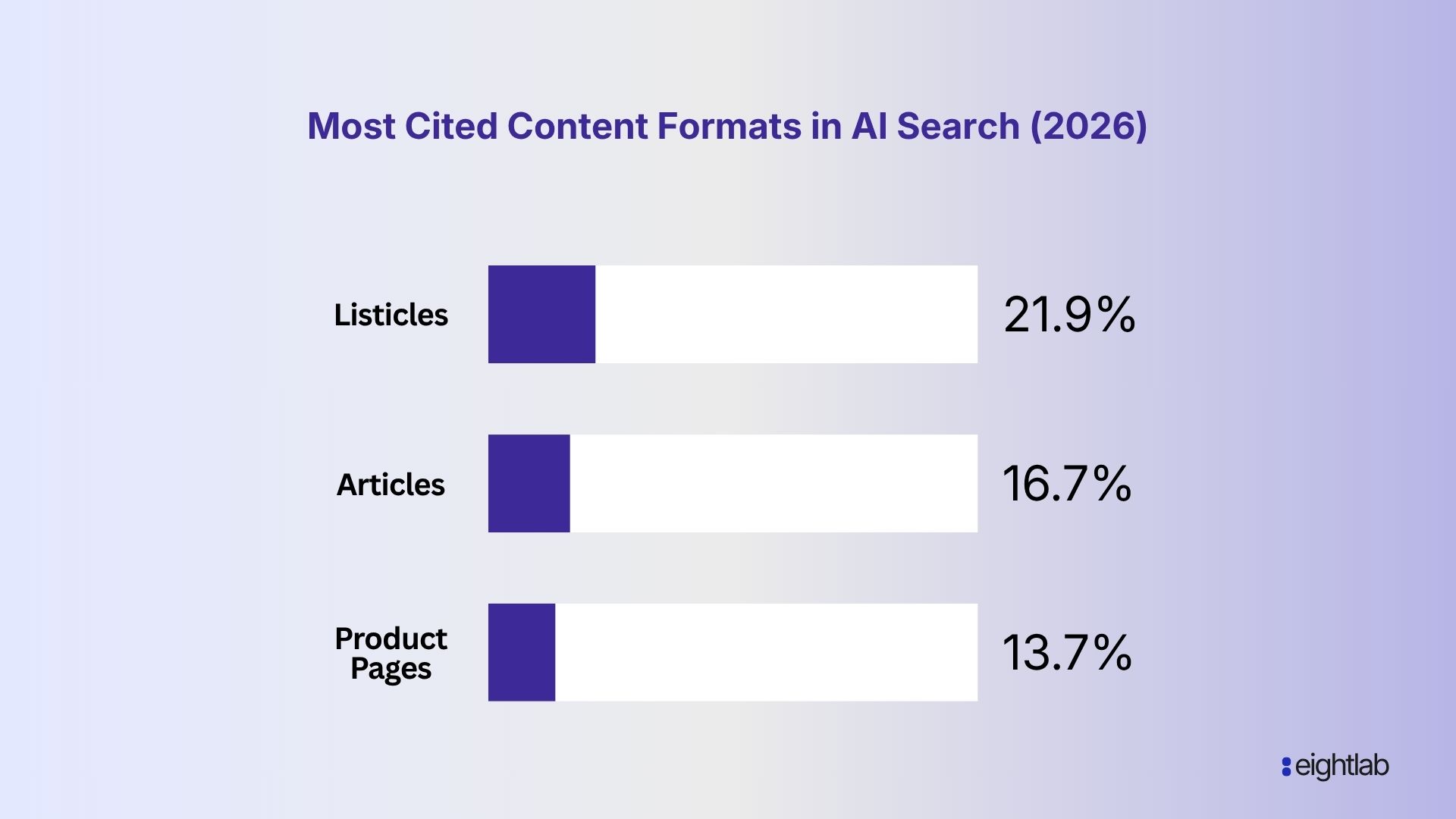
The practical implication: before writing a listicle, confirm that the query you are targeting has commercial intent. If your buyer is asking "how to" or "what is," an article with FAQ sections serves them better. If they are asking "best," "top," "vs," or "for [use case]," a listicle gives you the highest probability of citation.
The per-platform pattern also matters:
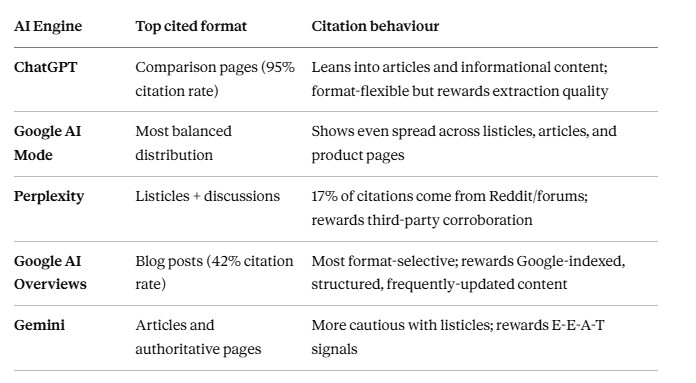
Use this table to match your listicle's angle to the AI engine most important to your buyers. For B2B SaaS buyers who research in ChatGPT, a comparison-structured listicle with a summary table is your highest-leverage format. For buyers using Perplexity, you need external corroboration from Reddit or review platforms alongside the listicle itself.
What structural requirements make a listicle extractable by AI?
A listicle that AI engines can cite reliably has seven structural characteristics. Each one directly affects the probability that the AI model selects your page as a source rather than a competitor's.
1. A title that names the number, the category, and the year
Titles using the format "X Best [Category] for [Use Case] in [Year]" outperform generic titles because they tell the AI model exactly what the list contains, how many items to expect, and whether the data is current. Include the year in every listicle title if you plan to refresh it annually. A title showing 2024 in 2026 actively reduces citation probability, AI models weight content freshness, and a dated title is the first signal of staleness.
Examples of citation-ready titles:
- "12 Best AEO Tools for B2B SaaS Teams in 2026"
- "8 Top AI Visibility Platforms Compared: Features, Pricing, and Use Cases"
- "15 B2B Marketing Tools That Get Cited by ChatGPT and Perplexity"
2. A TL;DR or summary table within the first 200 words
Kevin Indig's analysis of 1.2 million ChatGPT responses found that 44.2% of all citations come from the first 30% of page content. Front-loading is not optional, it is the mechanism by which AI engines primarily extract information.
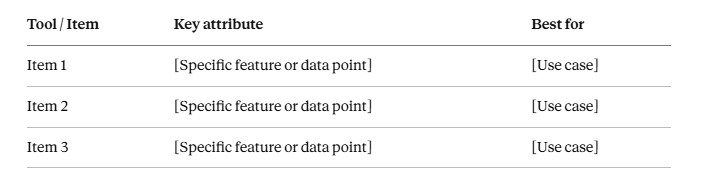
Place a summary table or a TL;DR block in the first 200 words. The table should include: item name, key attribute, and best-for scenario. This gives AI engines a directly parseable, tabular representation of your list before they have read a single full item entry.
Example summary table structure:
3. H2 headings for each list item — not H3 or bullet points
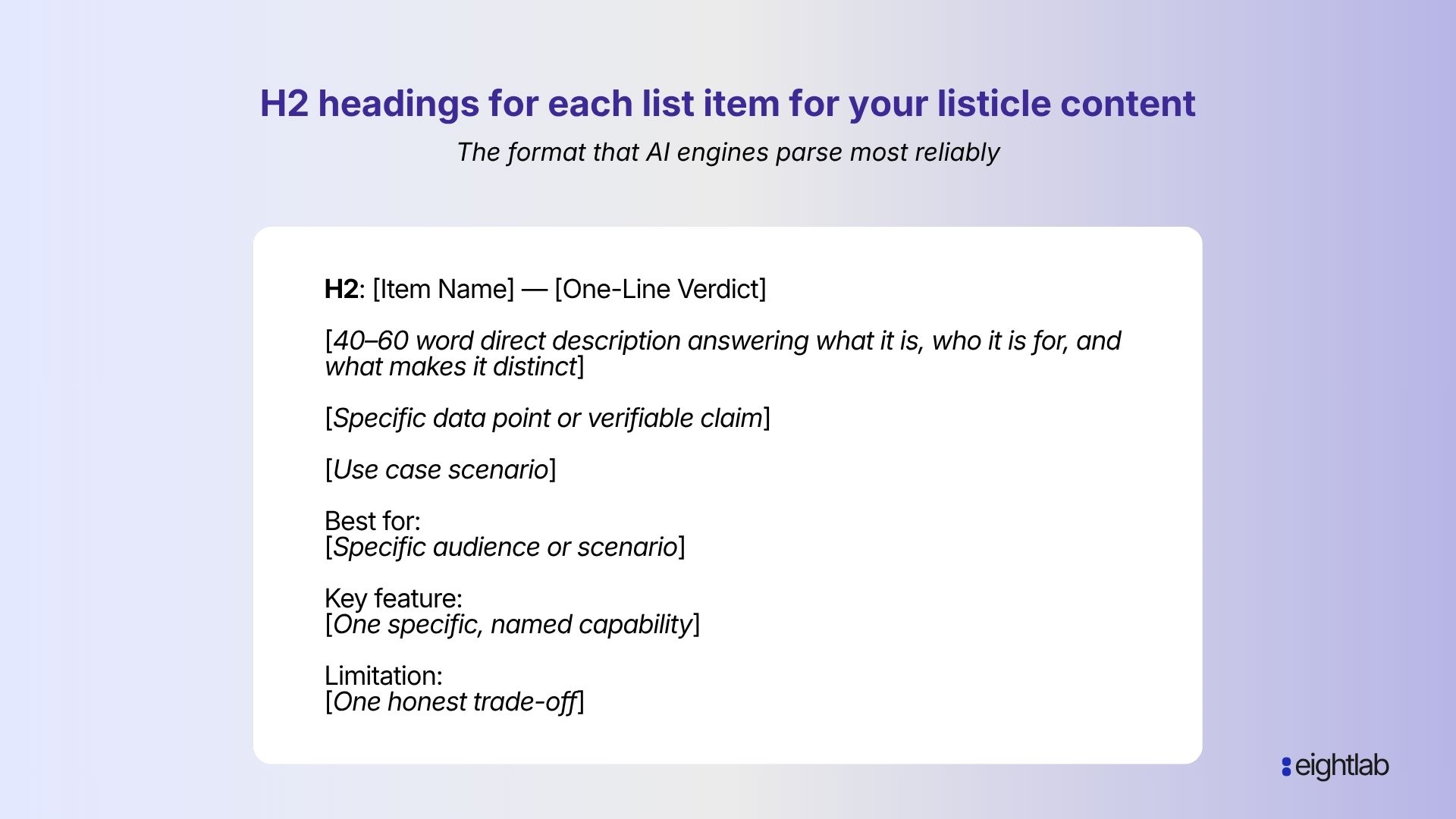
Each list item should be its own H2 section. This is the most important structural decision in an AI-optimised listicle. AI engines use heading hierarchy to parse content structure. An H2 heading signals a distinct, self-contained topic. An H3 signals a sub-topic within a larger section. A bullet point signals a list item within a paragraph.
When AI engines extract a listicle, they are most likely to pull from H2-headed sections because they represent the cleanest, most semantically complete unit of information. A bullet point list within a paragraph is harder to extract cleanly.
The format that AI engines parse most reliably:
4. Consistent structure across every item
If item 1 has a "Best for" label, a "Key feature" label, and a "Limitation" label, every item must follow the same pattern. AI models parse listicles by looking for structural consistency. Inconsistent formatting forces the model to parse each item differently, reducing extraction reliability.
Consistent structure also signals to the AI that your content was authored with editorial discipline rather than assembled quickly. That distinction affects citation probability, AI models are tuned to prefer content that appears authoritative and carefully produced.
5. One verifiable, specific data point per item
AI-cited articles cover 62% more facts than non-cited articles, according to 2026 research across 680 million citations. Every item in your listicle must contain at least one specific, verifiable claim: a percentage, a user count, a pricing figure, a study finding, or a named benchmark.
Vague descriptions do not get extracted. Specific claims do. "Tool X has a 4.7/5 rating on G2 from 1,200+ reviews" is extractable. "Tool X is highly rated" is not.
6. Items ranked 1–3 should receive the most detail
Among brands that appeared in third-party AI citation sources, 80% were positioned as one of the first three items mentioned in the cited content, according to AirOps' research. AI models disproportionately extract from the top of a list. Your three most defensible, best-supported items should come first, and each should have more evidence, more specific data, and a more complete description than items further down the list.
7. A "How we chose these" methodology section
Adding a short methodology section, explaining your selection criteria, data sources, and evaluation framework, signals editorial rigour that AI models treat as an E-E-A-T (Experience, Expertise, Authoritativeness, Trustworthiness) indicator. Listicles with stated methodology are more likely to be cited because they appear to represent considered analysis rather than arbitrary curation.
Place this section between the summary table and item 1, or at the end of the article before the FAQ.
How do you write each item in an AI-citable listicle?
Each item in your listicle should follow a four-part structure: verdict, evidence, use case, and trade-off. This matches the extraction pattern AI engines use when processing comparison content, the same structure that comparison pages with three or more tables earn 25.7% more citations.
The four-part item structure
Part 1 — Verdict (1–2 sentences)
State clearly what this item is and what makes it distinct from the others. Use definitive language: "is," "does," "offers," "delivers." Avoid hedging. Kevin Indig's February 2026 analysis of 11,022 ChatGPT citations found that citation winners were almost twice as likely to use definitive language (36.2%) compared to non-cited pages (20.2%).
Weak: "Tool X might be worth considering for teams that possibly need AI visibility tracking."
Strong: "Tool X tracks brand citations across five AI engines and delivers weekly visibility reports without manual prompt testing."
Part 2 — Evidence (1–3 sentences)
Provide at least one specific, verifiable data point. Named review counts, specific pricing, benchmark results, case study figures, user counts, or published research statistics all qualify. Generic descriptions do not.
Part 3 — Use case (1–2 sentences)
State specifically which buyer profile, company size, or scenario this item is best suited for. "Best for B2B SaaS marketing managers at companies with 20–200 employees" is extractable. "Good for most businesses" is not.
Part 4 — Trade-off (1 sentence)
Name one honest limitation. This is counter-intuitive but critical: AI engines are tuned to avoid promotional content. A listicle that acknowledges trade-offs signals balanced, trustworthy editorial content — the kind AI models are trained to prefer over purely promotional descriptions. One honest limitation per item dramatically improves the perceived credibility of the entire list.
How do you write the title, intro, and summary for maximum citation probability?
The title, introduction, and summary table are the three components that most directly affect whether AI engines extract from your listicle. They receive disproportionate citation weight because AI engines front-load their retrieval from the first 30% of page content.
Title Optimisation
A citation-ready listicle title has four components:
- A number — specificity signals completeness ("12 Best" outperforms "The Best")
- The category — named entity that matches how buyers phrase the query
- A use-case qualifier — who this list is for ("for B2B SaaS" or "for marketing managers")
- The year — currency signal that tells AI the content is fresh
Template: [Number] Best [Category] for [Use Case] in [Year]
Example: 12 Best AEO Tools for B2B Marketing Teams in 2026
Keep the SEO title under 60 characters for search appearance. The H1 on the page can be longer and more descriptive.
Introduction — the 50-word answer block
Every section should open with the direct answer in 40–60 words. For a listicle, the introduction's job is to answer "what is this list and why does it matter" in under 60 words, before any context or background.
After the direct answer, include two additional elements in the introduction:
- The total number of items and how they were selected ("We evaluated 35 tools and selected the 12 that best serve marketing teams at B2B SaaS companies between 10 and 200 employees")
- A 2026 data point that establishes why this list matters right now
The summary table
Place a summary table in the first 200 words. Tables are the highest-extraction-rate format in AI search. AI engines extract table data disproportionately because the structure is machine-readable and self-contained without requiring surrounding context.
The table should appear before item 1, not after. Buyers scan the table to decide whether to read the full list. AI engines extract the table as a standalone structured data unit. Both audiences are better served by seeing the table first.
What are the technical AEO requirements for a listicle?
Technical optimisation for AI search is as important as the writing. A well-structured listicle on a poorly optimised page will be overlooked by AI engines that cannot parse it reliably.
Schema markup
Add two schema types to every listicle:
ItemList schema — This is the most important schema for a listicle. It signals to AI engines that the page contains a structured list of items, each with a name, description, and URL. Google and Bing both use ItemList schema to understand and extract listicle content.
Article schema with dateModified — Add Article schema with the current dateModified date. AI engines weight content freshness, and a visible, machine-readable modification date signals that the content is current. Update this date every time you refresh the listicle.
FAQPage schema — Add a FAQ section at the end of every listicle and mark it up with FAQPage schema. This creates a second extraction surface for AI engines that prefer the Q&A format for informational sub-queries related to your list topic.
Meta description
Meta descriptions affect AI citation probability. Mike King from iPullRank explained in a February 2026 interview that "your metadata is the advertisement to the LLM to determine whether or not they're going to use your content." When AI models retrieve pages, they read the URL, title, and meta description to decide whether to fetch and use the full page.
Write your meta description as if you are pitching the page to a research assistant in one sentence. Name the number of items, the category, and the specific benefit. Keep it under 155 characters.
Template: [Number] [category] compared by [criteria]. Updated [Month Year]. Each entry covers [what each item includes].
Example: 12 AEO tools compared by pricing, features, and use case. Updated June 2026. Each entry covers citation tracking, action plans, and who it's best for.
Word count and heading frequency
The most-cited listicles reviewed in Search Engine Land's 25,000-URL analysis typically ranged from 1,000 to 2,000 words and averaged 18 words per sentence. They used structured H2 and H3 headings throughout, with 120–180 words between headings — the spacing verified to drive 70% more ChatGPT citations.
Aim for:
- 1,500–2,500 words total for a 10–15 item listicle
- 1 H2 per list item
- 120–180 words per item section
- 1 specific data point per 80 words of body content
Content freshness cadence
Pages not refreshed quarterly are 3x more likely to lose AI citations, according to AirOps' 2026 State of AI Search report. Over 35% of pages cited by ChatGPT were updated within the last three months, and over 70% within the last year.
For a listicle to maintain AI citations, set a calendar reminder to update it every 90 days. Each refresh should include: updated pricing or feature information for at least 3 items, a revised "last updated" date in the article header and in the Article schema dateModified field, and at least one new data point added to the introduction.
How do you audit an existing listicle for AI search?
If you have an existing listicle that is not earning AI citations, use this five-step audit to identify the structural gaps causing AI engines to skip it.
Step 1 — Test it manually.
Open ChatGPT, Perplexity, and Google AI Mode. Search the primary query your listicle targets (e.g. "best AEO tools for B2B SaaS"). If your listicle does not appear as a cited source, proceed to Step 2.
Step 2 — Check heading structure.
Open the page source and search for H2 tags. Are list items in H2 headings or buried in bullet points inside paragraphs? If items are not H2-headed, this is your highest-priority fix. Restructure the page so every list item is its own H2 section.
Step 3 — Check the first 200 words.
Count the words before the first H2. If there are more than 200 words of introduction before the summary table or first item, the page is under-front-loaded. AI engines primarily extract from the first 30% of content — if your best content is in the middle of the page, it is unlikely to be cited.
Step 4 — Check for verifiable data points.
Read each item and highlight any specific, verifiable claims: percentages, user counts, pricing figures, named ratings. If any item has no highlighted data point, add one before re-publishing.
Step 5 — Check the last update date and schema.
Confirm the Article schema dateModified field is current. Confirm ItemList schema is present. If either is missing, add them and resubmit the URL to Bing Webmaster Tools using IndexNow for faster AI engine discovery.
The goal is not to rewrite the listicle from scratch. The goal is to make each item independently extractable: a complete, self-contained unit that AI engines can pull and reuse without needing the surrounding context.
Key Takeaways
- Add three schema types to every listicle: ItemList schema (marking up each list item with name, description, and position), Article schema with a current dateModified date, and FAQPage schema for the FAQ section at the end of the article. Source citation improves by 30% when schema markup is included, according to 2026 AEO research. Add schema as JSON-LD in the page head — it is the format both Google and Bing process most reliably.Listicles account for 21.9% of all AI citations in AI Mode, ChatGPT, and Perplexity — the highest citation share of any content format, according to Wix Studio's analysis of over 1 million citations.
- 40.86% of commercial queries cite listicles. 45.48% of informational queries cite articles. Match your format to the query intent of your target buyer, not to what is easiest to write.
- Each list item must be an H2-headed, independently extractable unit with a one-sentence verdict, one verifiable data point, a named use case, and one honest trade-off.
- Items 1–3 carry the most citation weight — 80% of brands cited in AI search from listicle sources appear in the first three positions. Front-load your best-supported entries.
- Place a summary table in the first 200 words. AI engines extract 44.2% of citations from the first 30% of page content.
- Add ItemList schema, Article schema with dateModified, and FAQPage schema to every listicle.
- Refresh quarterly. Pages not updated within 90 days are 3x more likely to lose AI citations.
Frequently Asked Questions About AI Search Optimised Listicles
What makes listicles the most cited format in AI search?
Listicles account for 21.9% of all AI citations in AI Mode, ChatGPT, and Perplexity because their structure matches how AI engines extract information. Each numbered item provides a discrete, labelled, self-contained unit of information that AI models can pull and synthesise into answers without needing surrounding context. A "best X" listicle is the most directly reusable source for commercial-intent queries, which make up a large share of AI searches.
Should I use H2 or H3 headings for each list item?
Use H2 headings for each list item in an AI-optimised listicle. H2 headings signal a distinct, self-contained topic to AI engines. H3 signals a sub-topic within a larger section. When AI engines extract a listicle, they are most likely to pull from H2-headed sections because they represent the cleanest semantically complete unit. Reserve H3 for sub-points within an item, not for the item headings themselves.
How many items should an AI-optimised listicle contain?
There is no single correct number, but 8–15 items is the practical range for most B2B listicles. Fewer than 8 items reduces comprehensiveness signals; more than 20 items makes it difficult to give each item the structural depth AI engines reward. The 25,000-URL analysis found that the most-cited listicles typically ranged from 1,000 to 2,000 words — a length that supports 8–15 well-developed items within the AEO-optimal 120–180 words-per-section range.
How often should I update a listicle to maintain AI citations?
Update your listicle at least every 90 days. Pages not refreshed quarterly are 3x more likely to lose AI citations, according to AirOps' 2026 State of AI Search report. Each update should include: revised pricing or feature details for at least three items, an updated Article schema dateModified field, a fresh data point in the introduction, and a visible "Last Updated" date at the top of the page. IndexNow submission to Bing Webmaster Tools accelerates re-crawling by AI engines.
Does the order of items in my listicle affect AI citation probability?
Yes. AI engines front-load extraction from the first 30% of page content, and among brands cited in third-party listicle content, 80% appear in the first three positions. Place your best-supported, most defensible items in positions 1–3. These should have more detailed descriptions, more specific data points, and more complete use-case framing than items further down the list.
Which AI engines cite listicles most, and which are harder to earn?
ChatGPT, Google AI Mode, and Perplexity all favour listicles for commercial queries. Comparison content earns the highest citation rate on ChatGPT specifically at 95%, according to HubSpot's State of AEO 2026 report. Google AI Overviews are the most selective — only 14% of URLs cited by AI Mode rank in Google's top 10, and AI Overviews favour content that already has organic authority. Gemini declined "best of" listicle citations by 40% in 2026, rewarding instead more authoritative, data-backed comparative content.
What schema markup should I add to a listicle?
Add three schema types to every listicle: ItemList schema (marking up each list item with name, description, and position), Article schema with a current dateModified date, and FAQPage schema for the FAQ section at the end of the article. Source citation improves by 30% when schema markup is included, according to 2026 AEO research. Add schema as JSON-LD in the page head, it is the format both Google and Bing process most reliably.


