

Eightlab just completed analysis of 9.5 million AI citations. The finding is startling for B2B marketers: LinkedIn is the second-most cited source by ChatGPT, Claude, Copilot, and Google AI Overviews. Only YouTube ranks higher. This changes everything about how you should think about LinkedIn strategy. It is no longer just a social network. It is now a critical AI visibility channel and ignoring it while optimizing for Google is a strategic mistake.
What We Found
We analyzed 9.5 million AI citations across 16 B2B categories, tracking which sources ChatGPT, Claude, Google AI Overviews, Grok, and Gemini cited most frequently.
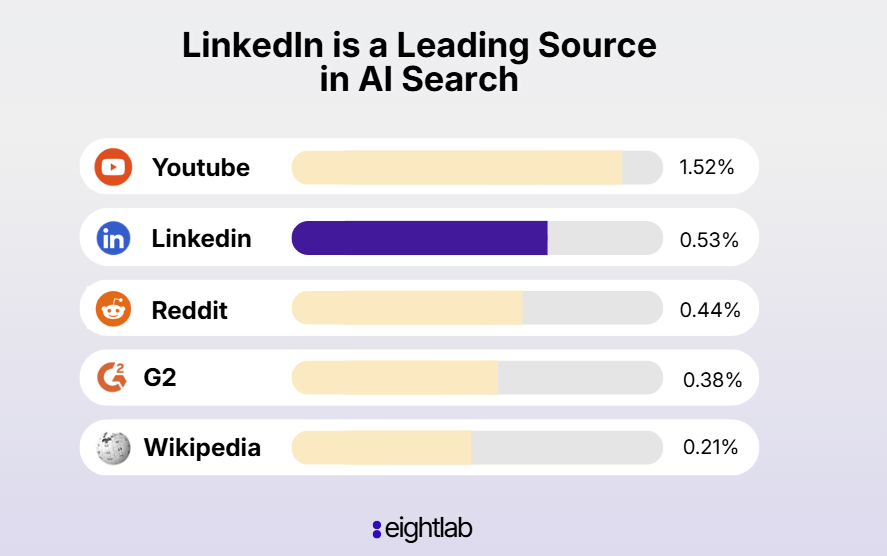
The results: LinkedIn accounts for 0.53% of all AI citations making it the second-most cited platform overall, behind YouTube at 1.52%. For comparison, Reddit sits at 0.44%, Capterra at 0.38%, and Medium at 0.21%.
For B2B specifically, LinkedIn ranks in the top 5 cited sources across critical categories: Technology and SaaS, Consulting and Professional Services, Financial Services and FinTech, Marketing and Advertising, Sales and Revenue, and HR and Talent. Even more striking: 94% of B2B buyers use LLMs during their buying process. If you are not showing up in those AI-generated answers, you are missing the moment of decision.
Finding 1: Individual Voices Drive 75% of All LinkedIn AI Citations
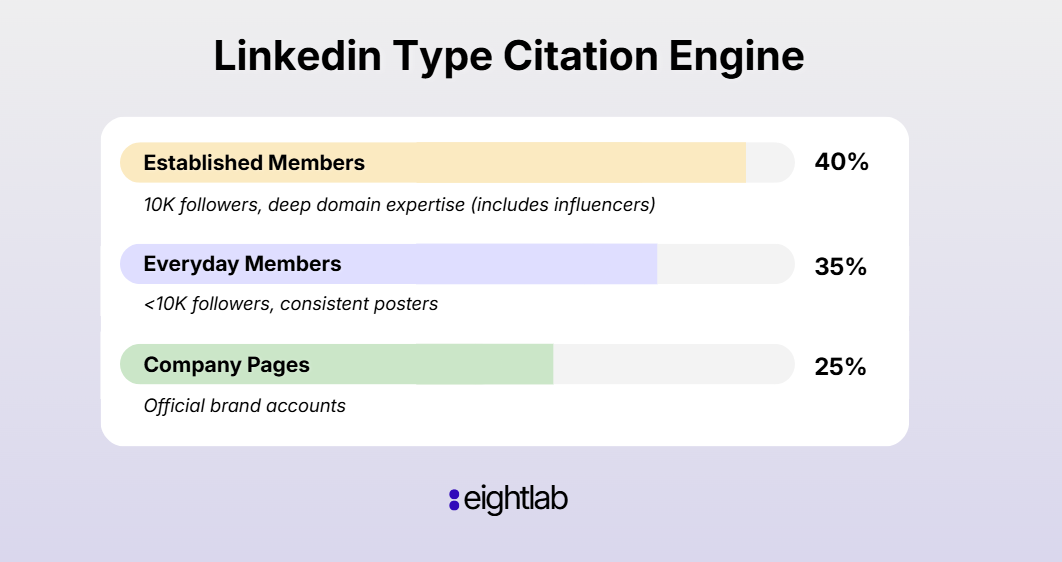
LinkedIn citations split 75% individual member profiles, 25% company pages. Your founder voice matters more than your corporate brand. This is critical. Our research shows that when AI models generate answers about what to do, which tool to use, or how to solve a problem, they cite people more than they cite companies.
Why? Because people are perceived as having expertise. Companies are perceived as having bias. When an AI model sees a founder or employee sharing insights in their own voice, it treats that as credible expertise. When it sees corporate copy from a company page, it discounts it as marketing.
Your founder voice should be your #1 content channel, not your company page. If you are a founder at an early-stage SaaS, your personal LinkedIn is now more important for AI visibility than your company LinkedIn page.
Publish regularly from your founder/exec account. Share insights, learnings, data, observations, things that establish your expertise. Keep your company page as supporting infrastructure. Link to founder content. Use it for corporate updates and hiring. But do not expect it to drive AI citations.
Encourage your team to publish. If you have experts in specific areas—engineering, product, marketing, customer success, get them publishing too. Each person is a citation channel.
Finding 2: Structured Content Gets Cited 3x More Often
AI models cite LinkedIn content that is formatted clearly. Bullet points, numbered lists, strong headings, named entities, and quantitative data are citation magnets. AI models prefer content they can parse easily. When they see a numbered list, clear headings, and specific numbers, they can extract and cite it with confidence. When they see a wall of paragraph text, they struggle to find citable snippets.
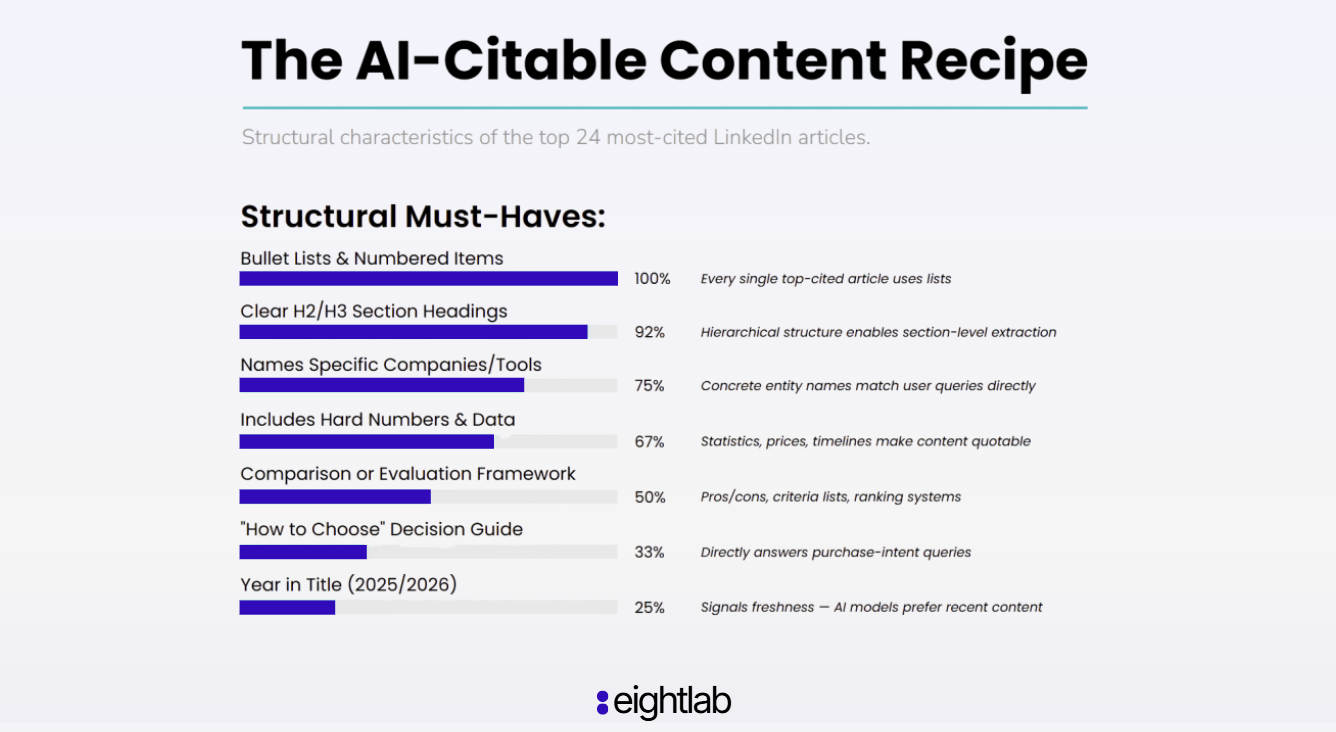
This is why the most-cited LinkedIn posts follow a specific format: a hook, a numbered list with clear structure, and specific data points.
The format that gets cited:
- Hook/opening statement (1-2 sentences)
- First insight (clear, scannable)
- Second insight (with numbers when possible)
- Third insight
- Fourth insight
- Fifth insight
- Call to action or closing thought
What to do about it:
- Stop writing paragraph-heavy LinkedIn posts. Use lists, bullet points, and clear structure.
- Include specific numbers when possible. AI models cite quantitative data more often than qualitative claims.
- Use clear headings and bold text. Break up your post visually. Make it easy to scan.
- Name specific things, people, and companies. AI models cite named entities more often than generic references.
- Front-load your most important insights. The first 2-3 items in a list get cited more than items 4-5.
Finding 3: Relevance Beats Reach
A post with 100 likes from your niche audience is cited more by AI than a post with 10,000 likes to a general audience. This is the opposite of how social media algorithms work. On Twitter or Facebook, reach drives visibility. On LinkedIn for AI citations, relevance drives visibility. When someone asks an AI model a question about your specific domain, the model will cite content that directly answers that question, not the content with the most engagement.
This is good news for smaller accounts. You do not need a massive following to get cited by AI. You need targeted, relevant expertise.
What to do about it:
- Write for your specific ICP and domain, not for maximum reach. A post about AI visibility optimization for B2B SaaS CMOs will get cited by AI more than a generic post about marketing.
- Go deep on your category. Do not try to cover everything. Become the person known for one thing really well.
- Answer specific questions your audience is asking. Solve real problems. That specificity is what AI models cite.
- Ignore viral metrics. Track citations instead. Ask: Is this content being referenced by AI assistants?
- Publish consistently on the same topics. Repetition builds topical authority. AI models recognize and cite topical authorities.
Finding 4: Original and Recent Content Wins
AI models cite fresh insights more often than evergreen or stale content. Original research, recent data, and current observations get prioritized. This is fundamentally different from SEO, where evergreen content and established authority dominate rankings. AI models reward recency and originality. A post from last week with new research will get cited more than a post from two years ago with the same information, even if the old post has more reach.
What to do about it:
- Publish original research and data when you can. We got cited heavily because we analyzed 9.5 million citations. The specificity and originality mattered.
- Share recent findings and insights from your work. Not lessons from 3 years ago, but what you learned this month.
- Create a consistent publishing schedule. Publish at least 2x per week if you want consistent AI citations. One post per month will not cut it.
- Put a date on your insights. "I just discovered..." or "This week's data shows..." signals recency.
- Do not republish old content hoping it will be discovered. Create new content instead.
Finding 5: Third-Party Sources Account for 47.5% of All AI Citations
Third-party and user-generated content (LinkedIn, Reddit, YouTube) drives 47.5% of AI citations. Company websites drive only 18.7%. Reviews and forums drive 15%. AI models trust third-party sources more than company sources. This is the same pattern we see in human behavior, you trust a friend's recommendation more than a company's self-promotion.
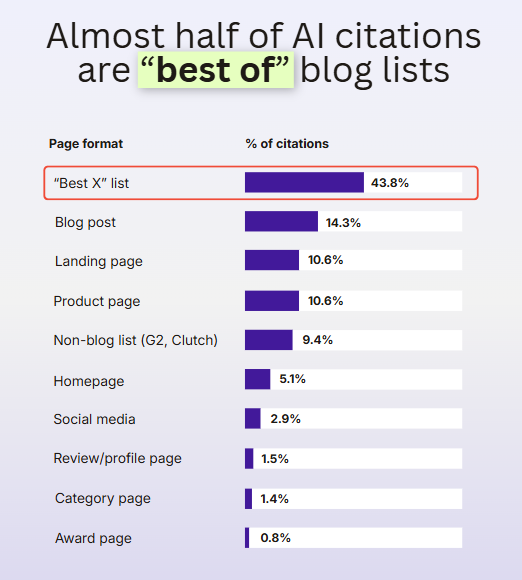
LinkedIn is a third-party source because while you own your profile, LinkedIn as a platform is independent. You are posting in a space where others are posting too. That independence signals credibility to AI models.
What to do about it:
- Prioritize LinkedIn over your company website for AI visibility. LinkedIn content will be cited more often than the same content on your website.
- Diversify across third-party platforms. LinkedIn is #2, but also publish on Reddit (niche communities), Medium, or industry platforms relevant to your category.
- Do not just push your website in LinkedIn posts. Use LinkedIn for insights and perspectives. Use your website for product information.
- Encourage customer testimonials and case studies to be published on third-party platforms (LinkedIn posts, Medium, review sites) rather than only on your website.
- Get mentioned in third-party discussions, podcasts, Reddit threads, industry blogs. These citations matter.
How These Five Patterns Compound
The five patterns reinforce each other. Individual voice plus structured content plus relevant specificity plus recent data plus third-party platform equals AI visibility. But there is a hierarchy. If you had to pick one to start with: start with individual voice. A founder publishing structured, relevant, recent content on LinkedIn will get cited by AI. A company page publishing the same content will not.
The implication is stark: your LinkedIn strategy is now as important as your SEO strategy. Both matter. But they require different approaches.
The Shift: From Search to Answers
For the last 20 years, B2B marketing has been about ranking. How do I rank on page 1 for my keyword? How do I drive organic traffic to my website?
AI search flips this. Now it is about being cited in the answer. You do not want someone to click a link to your website. You want ChatGPT to mention your name when answering their question.
This changes the entire content strategy. You are no longer optimizing for keywords and links. You are optimizing for citation—which means clarity, relevance, specificity, and credibility. LinkedIn is now the second-most important channel for B2B marketing because it is where third-party, expert-driven content lives. And that is exactly what AI models cite.
Quick Self-Assessment
Ask yourself:
- Are you publishing from your founder/executive personal account regularly? (Yes / No)
- Are your LinkedIn posts formatted with clear structure (lists, headings, bold text)? (Yes / No)
- Are you writing about your specific domain/category, or trying to appeal to a broad audience? (Specific / Broad)
- How often do you publish? (Daily / 2-3x per week / Once per week / Less)
- Do you track how often your insights get cited by AI assistants? (Yes / No)
If you answered No to the first three and Less to publishing frequency, you are missing out on the second-most important B2B visibility channel.
Your 90-Day LinkedIn to AI Citations Action Plan
Weeks 1-2: Set Up Your Foundation
- Optimize your LinkedIn headline to include your expertise area (not just your job title)
- Write a strong About section that makes clear what domain you publish in
- Commit to a publishing schedule (start with 2x per week)
- Study 5 highly-cited LinkedIn posts in your category and note their format
Weeks 3-8: Build Your Citation Track Record
- Publish 8-12 posts following the structured format (hook + numbered list + call to action)
- Use specific numbers and data whenever possible
- Write about your actual expertise and recent learnings
- Start engaging with others in your category (comment, reply, build visibility)
Weeks 8-12: Measure and Iterate
- Ask ChatGPT, Claude, and Perplexity questions in your domain. Do your posts get cited?
- Identify which of your posts AI models cite (if any)
- Study those posts. Replicate the format and approach
- Plan your Q2 content calendar with the formats and topics that work
The Metric That Matters: AI Citations
Stop tracking LinkedIn impressions and engagement. Start tracking AI citations.
Here is how: Ask ChatGPT, Claude, or Perplexity a question in your domain and see if your name or your insights appear in the answer. Ask the AI assistant where it got the information. If it cites your LinkedIn post, that is a data point.
Track this monthly. How many times did AI models cite your LinkedIn content in response to category-relevant queries? That is your north star metric. Not likes. Not impressions. Citations.
The Metric That Matters: AI Citations
- LinkedIn is now the second-most important visibility channel for B2B, after YouTube. Ignoring it is a strategic mistake.
- Your founder voice matters more than your company voice. Prioritize personal accounts over corporate pages.
- Structured content with clear formatting gets cited 3x more often. Use lists, bullet points, and bold text.
- Relevance beats reach. A niche post about your domain will get cited more than a viral post to a general audience.
- Recency and originality matter. AI models cite fresh insights and recent data over old evergreen content.
- Third-party sources drive 47.5% of AI citations. LinkedIn as a third-party platform is more credible than your website.
The Next Three Years Are About Being Cited, Not Ranked
Product discovery is no longer a search results game. It is an AI answers game. When a prospect asks ChatGPT what tool to use, what strategy to adopt, or how to solve a problem, the answer they get is shaped by what AI models choose to cite.
LinkedIn is now one of the top sources for those citations. Your ability to show up in those answers depends on publishing regularly, clearly, and authentically from your personal account on topics where you have real expertise. The brands that win the next three years will not be the ones with the most links. They will be the ones cited most often by AI models. And increasingly, that means being visible on LinkedIn.
About the Author
Olivia Dewi is co-founder of Eightlab, which helps B2B brands measure and improve their visibility in AI search (ChatGPT, Claude, Perplexity, Gemini). She started Eightlab after discovering her own design business was invisible in ChatGPT despite strong Google rankings. She now researches how AI models decide which brands to recommend and shares insights on LinkedIn about AI visibility strategy.
You can follow her on LinkedIn or visit Eightlab at eightlab.co


