


AI Overviews are the AI-generated summaries Google places at the top of search results, synthesising information from multiple sources into a single answer with linked citations. They now appear on roughly 30% of all searches, and being cited inside one has become a measurable, trackable outcome. This guide covers how AI Overviews are actually built, what the data says about their effect on traffic and revenue, and the specific technical and content decisions that improve citation odds.
What Is an AI Overview?
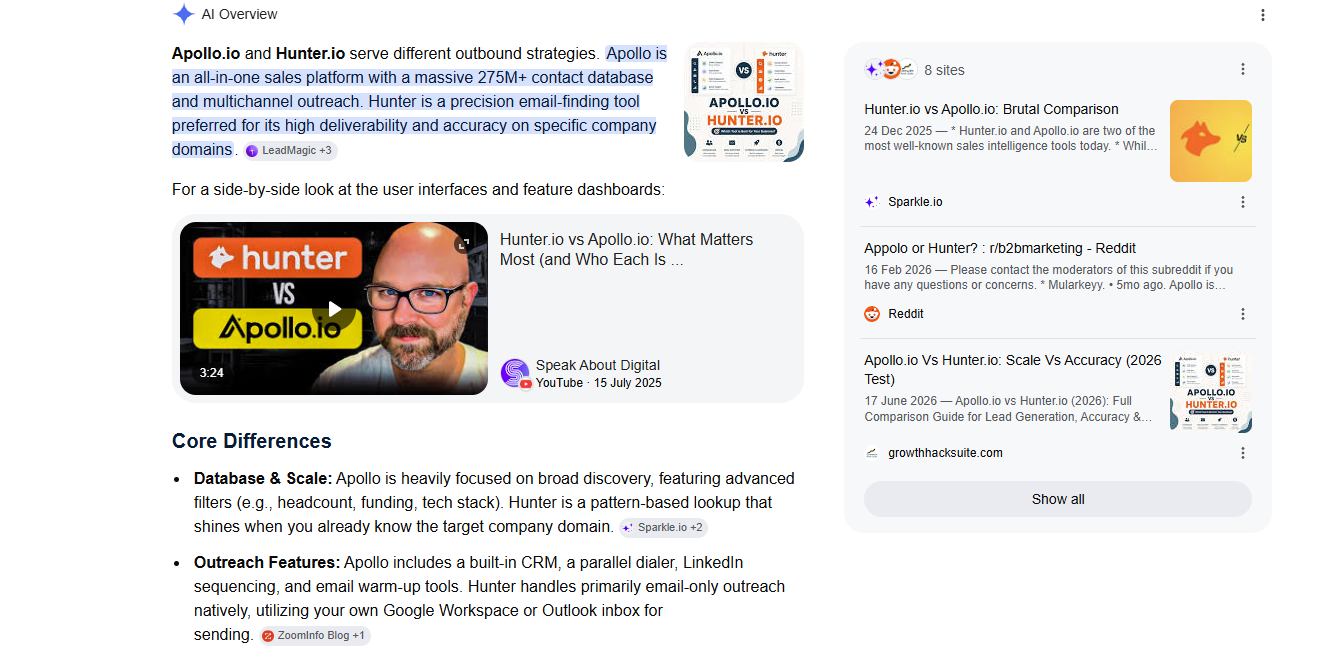
An AI Overview is a generative-AI summary that Google inserts above traditional search results, drawing on multiple web sources to answer a query directly and linking out to the pages it used. Unlike a featured snippet, which quotes one page, an AI Overview typically synthesises language and data from several sources into a single new passage, then cites each one in a sidebar or inline link.
For a searcher, the effect is straightforward: instead of scanning ten blue links, they get a synthesised answer with the option to click through for more depth. For a brand, the effect is different depending on whether your page was one of the sources used. If it was, you get a citation, brand exposure at the top of the page, and a smaller but often more qualified click. If it wasn't, your organic listing, even a strong one, is pushed further down the page.
When Does Google Show an AI Overview?
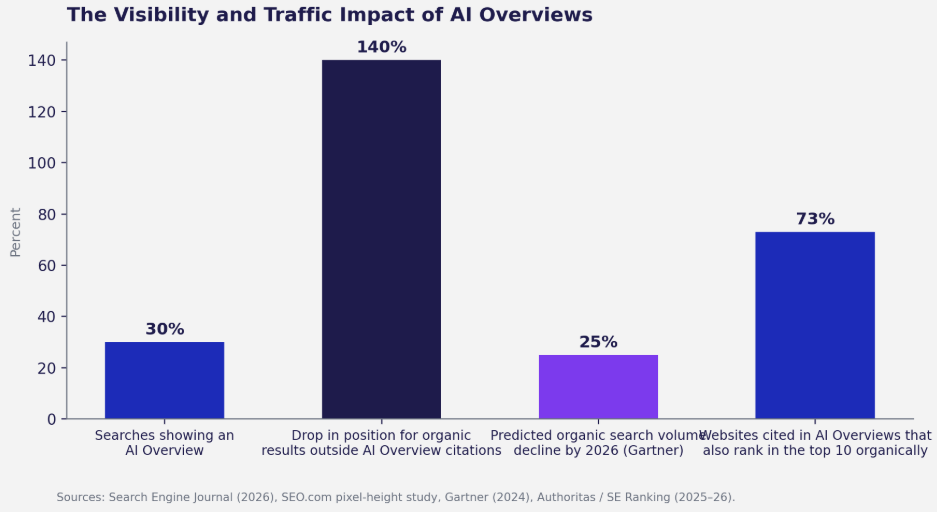
Google shows an AI Overview when its ranking systems determine that a generated summary will answer the query faster or more completely than a standard results page, and this now happens on close to 30% of all searches, according to 2026 tracking by Search Engine Journal. Informational queries, such as the kind that start with "what," "how," or "why", will trigger AI Overviews more often than transactional or highly localised queries.
The pattern is intuitive once you see it. A query like "what has more caffeine, coffee or tea" has one direct, factual answer that doesn't require browsing a page. A query like "book a flight to Melbourne" or a specific local service search is far less likely to trigger one, because the intent is transactional and the "answer" is an action, not a fact.
For B2B SaaS and service brands, the relevant pattern is this: comparison queries, definitional queries ("what is X"), and "best X for Y" queries are exactly the query types your buyers use when researching a purchase, and they're also the query types most likely to surface an AI Overview.
What Determines Which Sources an AI Overview Cites?
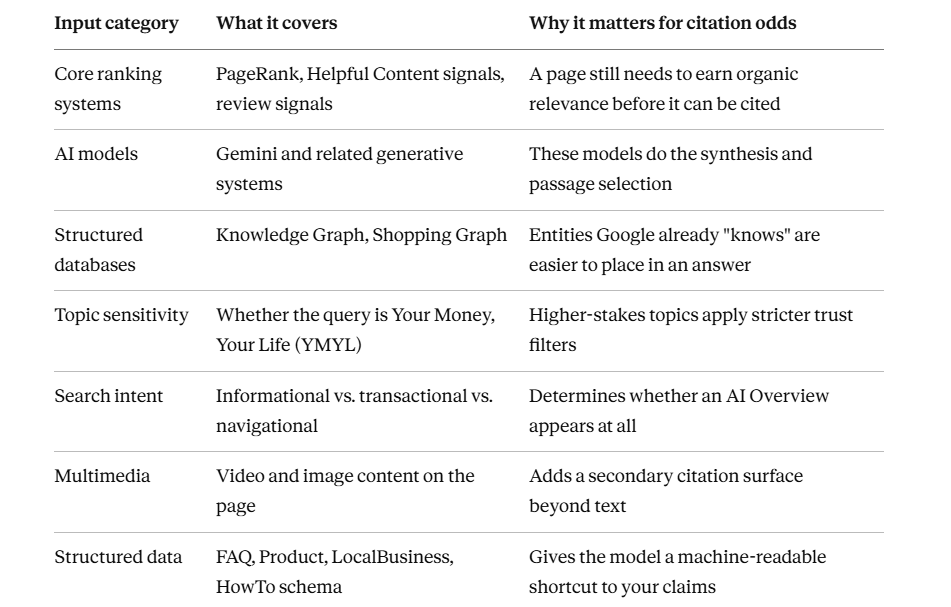
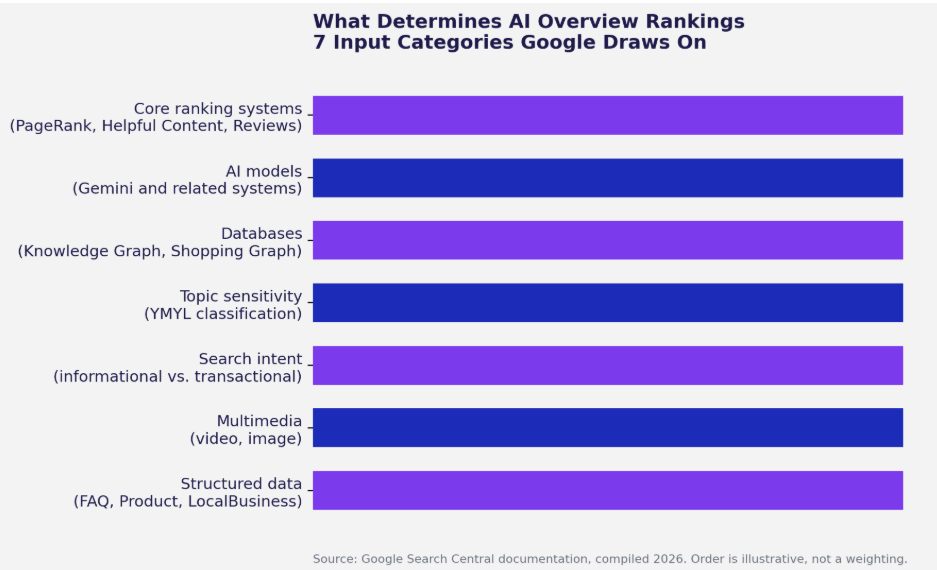
AI Overview citations are drawn from seven overlapping input categories: Google's core ranking systems, its underlying AI models, structured databases like the Knowledge Graph, the sensitivity of the topic, the type of search intent, the presence of multimedia, and structured data markup on the page. No single factor guarantees a citation, Google combines signals from all seven before selecting and synthesising sources.
How Are AI Overviews Actually Generated?
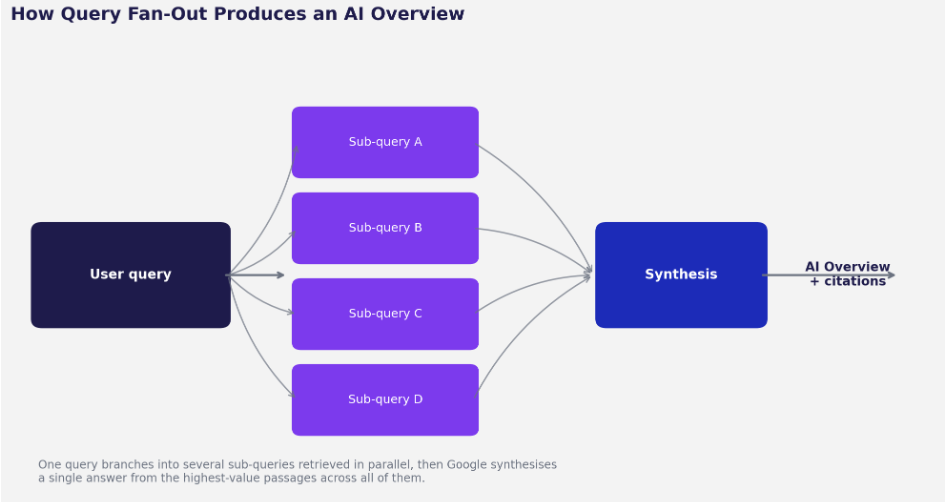
Google generates an AI Overview by breaking one search query into several related sub-queries, retrieving results for each in parallel, and then synthesising the highest-value passages into a single answer with citations, a process known as query fan-out. This is the mechanical detail most content teams miss, and it's the reason a page that never targeted your exact head keyword can still get cited.
Step 1: One query becomes several
When someone searches "business casual wedding attire," Google doesn't run that single query once. It fans the query out into related sub-queries, what women should wear, what men should wear, appropriate footwear, whether a tie is expected and retrieves results for each of them at the same time. The final AI Overview is built from whichever pages answered those sub-queries best, not necessarily the pages that rank #1 for the exact head term.
Step 2: Passages get selected and cited
Once the parallel retrieval is done, the system identifies the passages it judges most directly useful across all the sub-queries, stitches them into a coherent answer, and attaches citation links to the sidebar and inline text. This is why a supporting blog post or a subtopic page, not your flagship pillar page, can end up being the page that actually gets cited. Content clustering, where you build out full coverage of a topic's sub-questions rather than one dense page, directly increases the number of doors your content has into an AI Overview.
Step 3: The searcher sees the citation
The final answer displays with visible source links, both inline and in a sidebar module the user can expand to see every source used. This is the moment brand visibility is actually built or lost, a citation here puts your name in front of a searcher who may never have scrolled past the AI Overview to see your organic listing at all.
How Do AI Overviews Change SEO?
AI Overviews change SEO in three measurable ways: they compress the visibility available to non-cited pages, they reduce raw click volume while often improving the quality of the traffic that does click through, and they create a revenue dynamic where ranking well still correlates strongly with being cited. None of these are hypothetical, each has been directly measured across 2025–2026 studies.
1. Visibility gets compressed
An AI Overview module occupies more than 1,700 vertical pixels at the top of the page, and independent tracking has found that traditional organic results shift down the page by more than 140% on average once an AI Overview appears. Being one of the (typically three) linked sources inside the Overview largely offsets that compression. Being outside it does not.
2. Traffic drops, but the traffic that remains is often better qualified
Zero-click behaviour rises with AI Overviews the same way it did with featured snippets, a factual query gets answered on the results page and the session ends there. The more interesting finding across 2025–2026 reporting is that overall revenue doesn't always fall in step with traffic. HubSpot's own 2024 numbers are the most-cited public example: reported organic traffic fell sharply year-over-year even as the business posted 21% revenue growth for the same period, according to its Q4 2024 earnings call. The interpretation most analysts converge on is that AI-answered queries were disproportionately low-intent ("what has more caffeine, coffee or tea") while the traffic that still clicks through skews toward higher-intent, more qualified visitors.
3. Revenue still rewards strong organic fundamentals
Two independent 2025–2026 studies, one from Authoritas, one from SE Ranking, both found that roughly three-quarters of the domains cited inside an AI Overview also rank in the traditional top 10 for the same query (74% and 73% respectively). Gartner separately projects a 25% decline in traditional organic search volume by 2026 as AI-native search and chat interfaces absorb query volume. Read together, the two data points make the same point from different angles: AI Overviews are not replacing the value of strong SEO fundamentals, they're adding a second, higher-visibility layer on top of them, and Google continues investing heavily here, having earmarked USD 75 billion for AI infrastructure in 2025 alone.
How Do You Track Whether You're Being Cited?
You can track AI Overview performance by combining Google Search Console data with a dedicated AI-visibility tool, because GSC records impressions and clicks from AI Overviews but does not let you filter that data out from standard organic results. This blended-data problem is the single biggest operational gap in AI-era SEO reporting right now.
Google Search Console will show AI Overview and AI Mode impressions inside your existing performance data, but they're merged with standard organic metrics rather than broken out into their own view. Third-party AI visibility platforms, including Eightlab, solve this by running standardised, repeatable prompts against multiple AI engines (ChatGPT, Claude, Perplexity, Gemini, and Google AI Overviews) and reporting a brand's citation rate, sentiment, and competitive position across each one separately. This is the difference between knowing "some of our traffic might be AI-influenced" and knowing "we're cited in 12% of the prompts we tested this month, up from 4% last quarter."
How to Improve Your Odds of Being Cited in an AI Overview
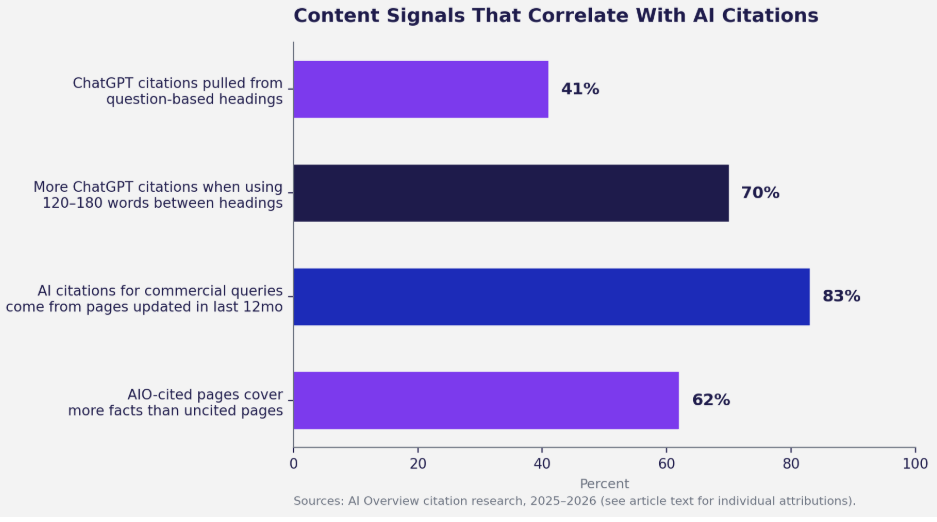
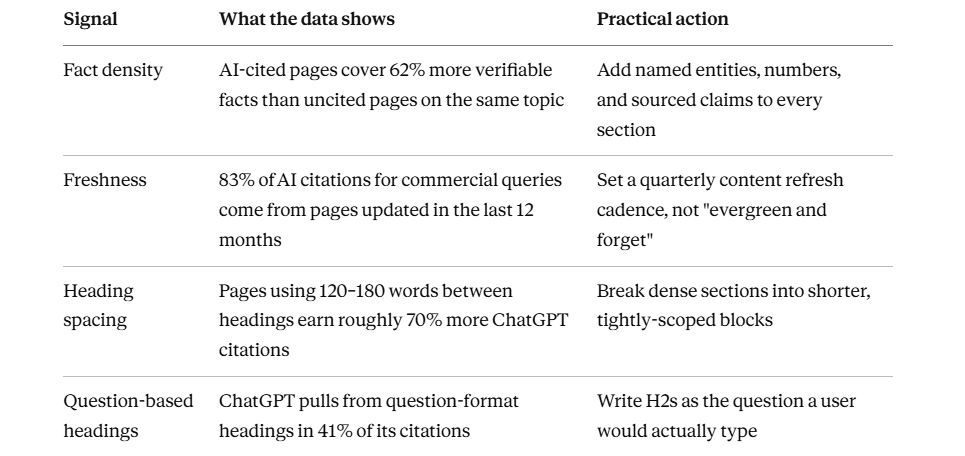
Five levers consistently correlate with higher AI Overview and broader AI-search citation rates: strong core SEO fundamentals, specific and evidence-based content, content that anticipates the searcher's next question, structured data markup, and relevant multimedia. None of these are exotic, most are extensions of practices strong SEO teams already run, applied with more precision.
-
Strong core SEO fundamentals
AI Overviews are built on top of Google's existing ranking systems, so a page still has to clear the same bar it always did: helpful, original content; a logical site architecture; genuine backlinks; and consistent reviews and reputation signals on and off your own site. If your page isn't earning organic relevance in the first place, no amount of AI-specific formatting will get it cited. -
Add specificity, not adjectives
Generative engines consistently favour content with anecdotal detail, cited data, and precise direction over vague, adjective-heavy copy. "Monitor for 10 days" gets used ahead of "monitor the data regularly." This lines up with the same E-E-A-T principles (Experience, Expertise, Authoritativeness, Trustworthiness) that already govern traditional ranking — AI systems are simply applying the same trust filter to a synthesis task instead of a ranking task. -
Anticipate the next three questions
An AI Overview is, by definition, an overview — it's built to answer a cluster of related sub-questions in one pass, not a single narrow query. A page written to answer only its target keyword misses most of that cluster. A page written to also answer what a reader will ask next — the second and third-order questions a curious searcher has — has more surface area across the query fan-out process described above. -
Structured data is a direct signal, not a formatting nicety
Schema markup — FAQ, Product, Article, HowTo, LocalBusiness — gives Google a machine-readable version of your claims instead of forcing the model to infer structure from prose. Recipe schema is one of the most consistently cited examples in AI Overview source analysis, because it hands the model an exact, unambiguous list of ingredients and steps. Free tools like Google's Structured Data Markup Helper make this achievable without a developer for most standard page types. -
Multimedia adds a second citation surface
Video and image content give an AI Overview a second way to reference your page beyond quoted text, and AI Overviews are measurably more likely to cite YouTube specifically among video platforms. A well-labelled diagram, a short explainer video, or a properly alt-tagged image isn't just for accessibility — each one is an additional entry point into how the model can represent your content.
Frequently Asked Questions About AI Overviews
Do AI Overviews replace traditional Google search results?
No. AI Overviews sit above traditional organic results rather than replacing them, and the two systems draw on largely the same underlying ranking signals. A page still needs to rank well organically to have a realistic chance of being cited inside the AI Overview above it.
How often do AI Overviews actually appear?
AI Overviews appeared on approximately 30% of tracked searches as of 2026 reporting from Search Engine Journal, with informational queries triggering them far more often than transactional or highly local ones.
Can a smaller or newer website get cited in an AI Overview?
Yes, if the specific page answers a sub-query precisely and with structured, well-sourced detail. Citation is passage-level, not domain-level, Google's query fan-out process can surface a smaller supporting page over a bigger competitor's page that only covers the topic broadly.
Does losing AI Overview visibility mean losing all search traffic?
Not necessarily. Reported cases such as HubSpot's 2024 results show organic traffic can fall while revenue rises, because the remaining clicks skew toward higher-intent visitors. The safer framing is that AI Overviews change the shape of your traffic, not just the volume.
What's the difference between AI Overviews and Answer Engine Optimisation (AEO)?
AI Overviews are one specific surface — Google's own generative search feature. AEO is the broader discipline of optimising a brand's visibility across every AI-generated answer surface, including AI Overviews, but also ChatGPT, Perplexity, Claude, and Gemini as standalone products, each with different citation behaviour.
How do I know if my competitors are being cited more often than I am?
You need a tool that runs the same standardised prompts against your brand and your named competitors on a recurring basis and reports the gap directly, this is exactly what an AI Visibility Audit is built to show in about 90 seconds.
Key Takeaways
- AI Overviews appear on roughly 30% of searches and are generated through query fan-out — one query splitting into multiple sub-queries retrieved and synthesised in parallel.
- Citation is decided at the passage level, not the domain level, which means well-structured supporting content can be cited ahead of a bigger, broader competing page.
- Strong core SEO — helpful content, backlinks, reviews, clean architecture — remains the floor. AI Overviews add a synthesis layer on top of it, not a replacement for it.
- Traffic volume and revenue don't always move together under AI Overviews; qualified intent matters more than raw click count.
- The five levers that most reliably improve citation odds are SEO fundamentals, factual specificity, anticipating follow-up questions, structured data, and multimedia.
- Google Search Console can't isolate AI Overview data on its own — pair it with a dedicated AI visibility tool for a clear, competitor-benchmarked picture.


