

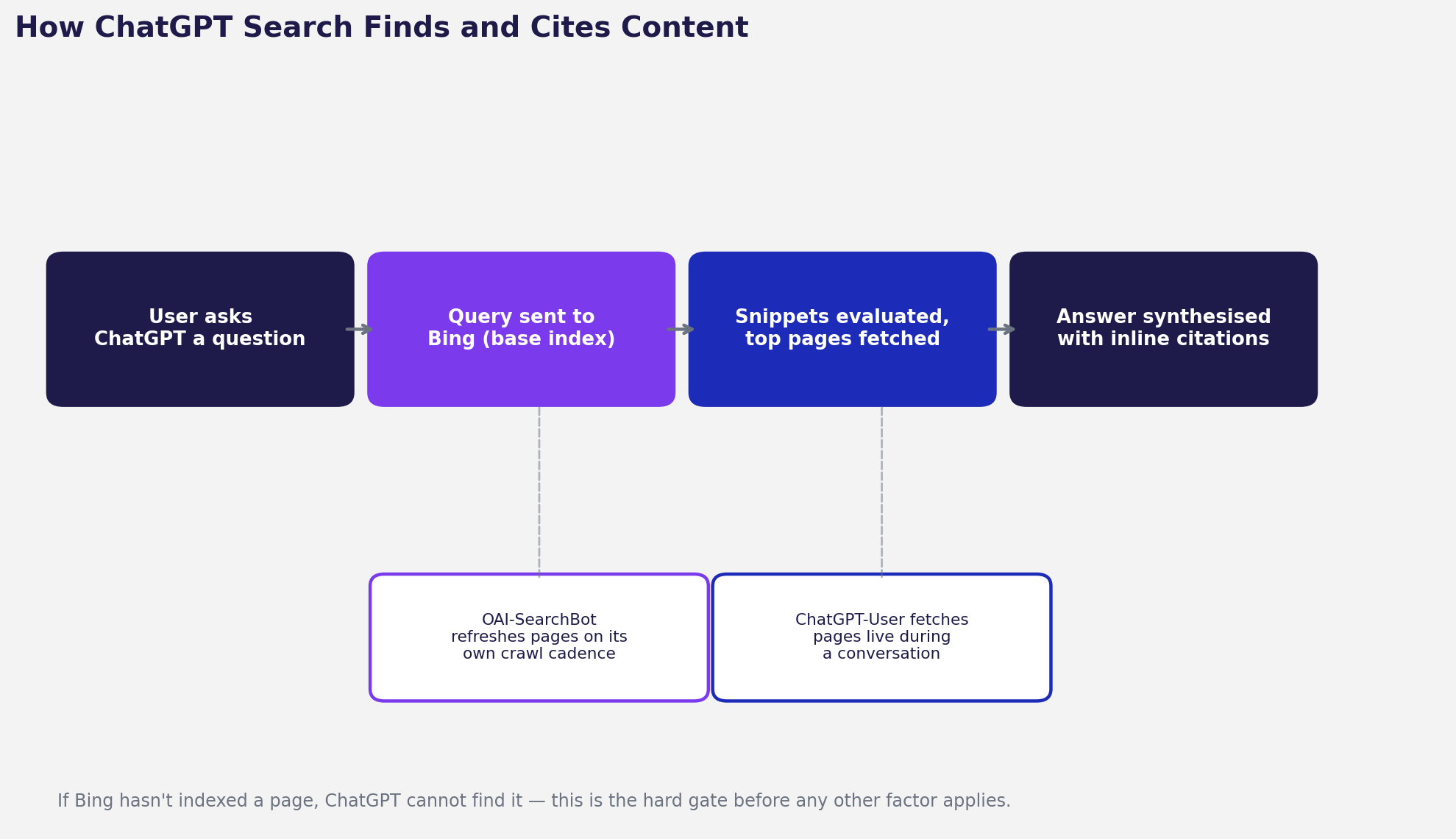
ChatGPT Search finds citable content through Microsoft Bing, not Google, every URL ChatGPT can reference was first surfaced through the Bing API, which makes Bing indexation the single hardest gate in the entire system. From there, ChatGPT evaluates snippets, selectively fetches the strongest candidate pages, and synthesises a narrative answer with inline citations.
Most AEO advice treats every AI engine the same way. They're not the same system, and the differences change what you should actually do. This guide is specific to ChatGPT: how it retrieves content, what the current evidence says drives citation, which domains it cites most, and the five-step playbook that follows from the data, with the confidence level behind each claim, because in a fast-moving category, knowing what's confirmed versus practitioner-reported matters as much as the claim itself.
What Is ChatGPT Search and How Does It Find Content?
ChatGPT Search finds content by sending optimised queries to Microsoft Bing, evaluating the snippets Bing returns, then selectively fetching the full page content of the strongest candidates before writing a synthesised answer with inline citations. OpenAI confirmed the Bing partnership at ChatGPT Search's launch, which means Bing's index is the base layer every citation is built on.
Two supplementary crawlers extend that base layer beyond a single Bing snapshot:
- OAI-SearchBot refreshes specific pages on its own cadence, independent of when Bing last crawled them
- ChatGPT-User fetches pages live, in real time, during an active conversation
Both matter operationally. OAI-SearchBot means your content can get picked up faster than a slow Bing crawl cycle would suggest. ChatGPT-User means a page can be read at the exact moment someone asks about it, but it doesn't execute JavaScript, and as of December 2025 it's reported to ignore robots.txt restrictions. If your site depends on client-side rendering to display core content, ChatGPT-User may not see what a human visitor sees.
The practical implication is simple and easy to skip: if Bing hasn't indexed your page, no amount of on-page optimisation matters, because ChatGPT never sees the page at all. Bing Webmaster Tools is the first thing to check, not the last.
How Does ChatGPT Decide What to Cite?
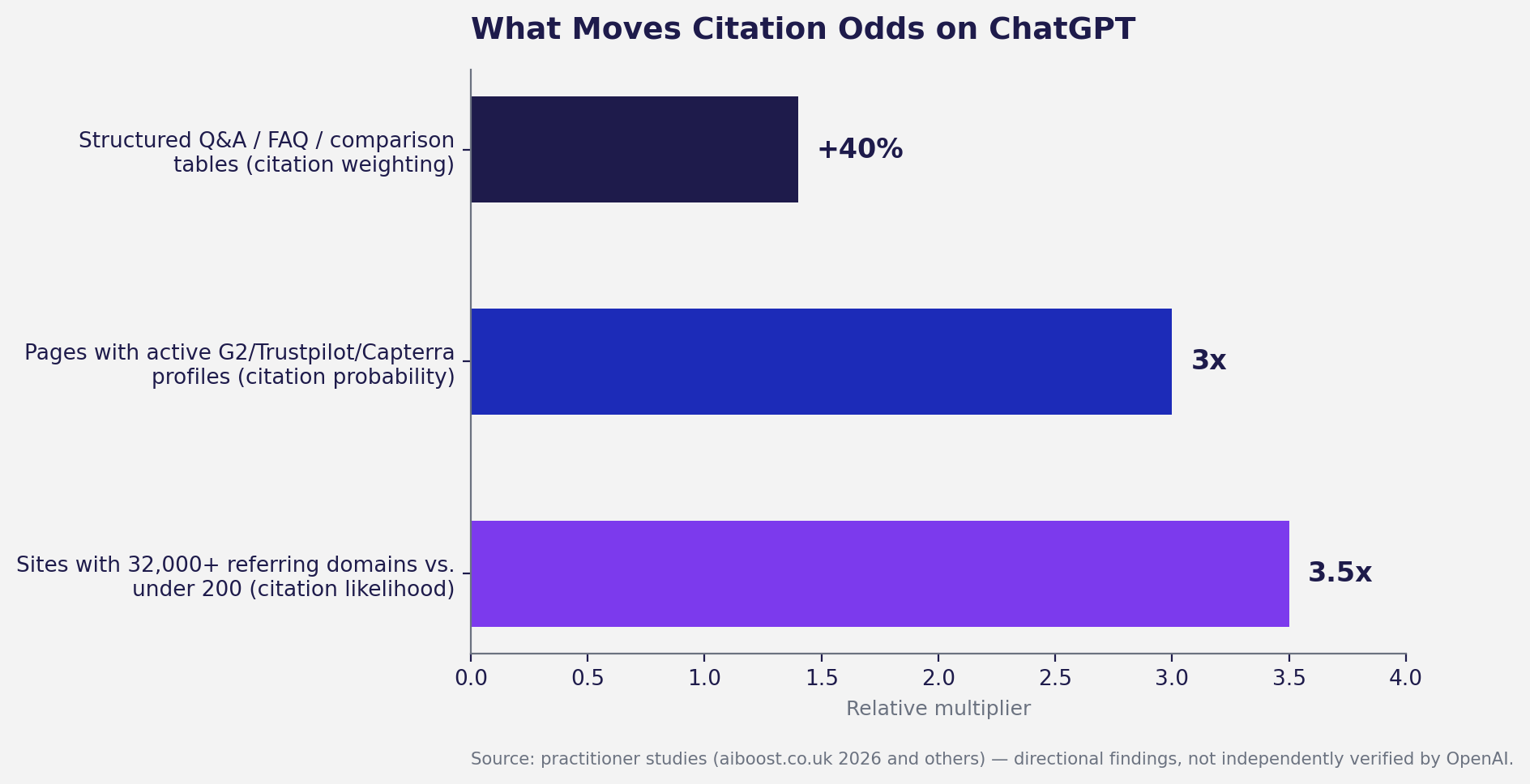
ChatGPT weighs Bing indexation as a hard gate first, then ranks candidate pages using domain authority, where the answer sits on the page, whether the content uses structured Q&A formatting, and whether the brand carries third-party trust signals like G2 or Trustpilot reviews. These factors are ordered here by strength of evidence, from confirmed mechanism to practitioner-reported pattern.
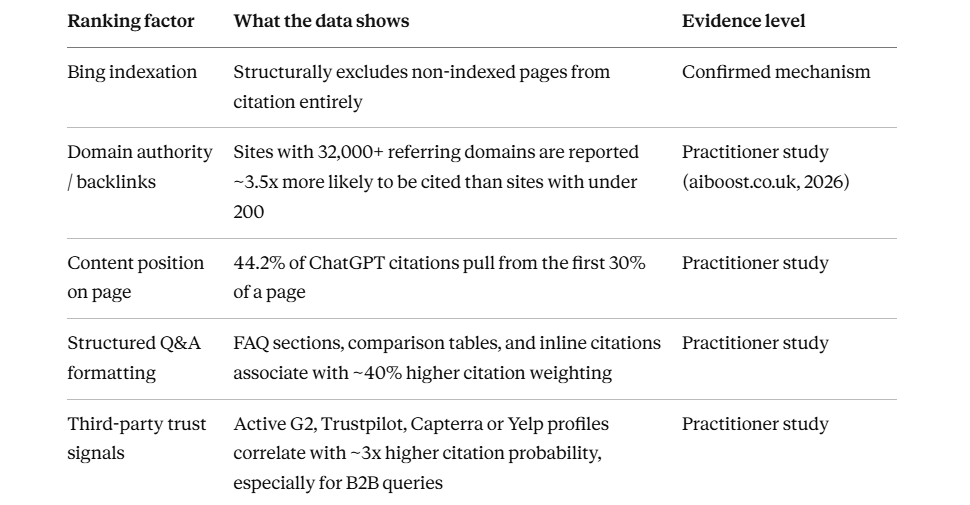
Two of these are worth sitting with if you're a B2B SaaS brand specifically. Third-party trust signals carry outsized weight for exactly your query category, a marketing manager asking ChatGPT to compare tools is a commercial query, and commercial queries lean harder on review-site presence than informational ones. And content position means your direct answer needs to appear before your brand story, not after it, the opposite order of how most "About" and product pages are written today.
Which Domains Does ChatGPT Cite Most Often?
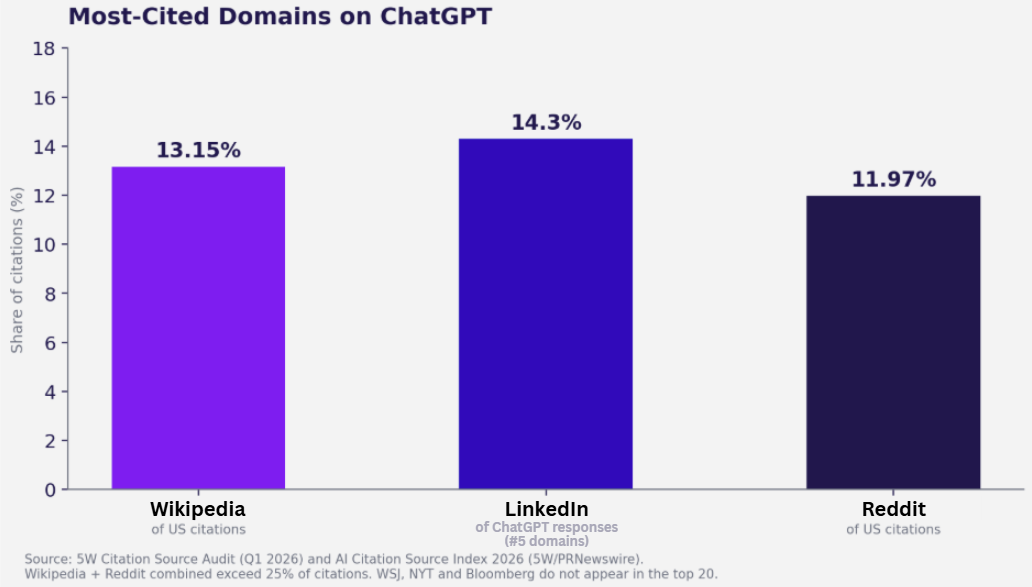
Wikipedia is the single most-cited domain on ChatGPT, at 13.15% of US citations, with Wikipedia and Reddit combined exceeding a quarter of all citations, according to the 5W Citation Source Audit (Q1 2026), which synthesised nine independent datasets across hundreds of millions of citations. LinkedIn is the fastest-moving domain in the same period, jumping from the #11 to the #5 most-cited domain in three months and now appearing in 14.3% of ChatGPT Search responses.
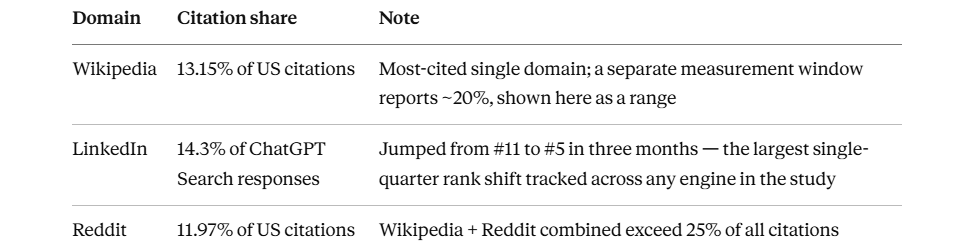
Notably absent from the top 20: The Wall Street Journal, The New York Times, and Bloomberg. Traditional publisher authority does not translate directly into ChatGPT citation share the way it does in traditional search rankings — community and reference platforms currently dominate instead. The LinkedIn shift is the one to watch closely: a platform jumping six ranking positions in a single quarter suggests ChatGPT's source weighting is still actively changing, not settled.
How Do You Get ChatGPT to Recommend Your Business?
Getting cited by ChatGPT starts with confirming Bing indexation, then front-loading the direct answer in the first 30% of the page, adding FAQ-formatted sections that match real buyer questions, building third-party trust signals on G2 and Capterra, and publishing comparison content. These five steps are ordered by where the evidence says the leverage is highest, starting with the gate that determines whether anything else matters.
1. Confirm Bing indexation first
Open Bing Webmaster Tools and check whether your key pages are actually indexed. This is the single hardest gate in the entire system, nothing else on this list has any effect if Bing hasn't crawled the page. A clean sitemap and server-rendered (not purely client-side) content are the two most common fixes when indexation is the problem.
2. Put the direct answer in the first 30% of the page
Write a two-to-three sentence direct-answer block immediately after your heading, before supporting detail, backstory, or brand framing. 44.2% of ChatGPT citations are pulled from the first third of a page, content buried below marketing copy is structurally less likely to be selected.
3. Add FAQ-formatted sections addressing real buyer questions
Structure content around the specific questions your buyers actually type into ChatGPT, not generic keyword targets. Comparison tables and inline citations belong in this section too, structured Q&A formatting associates with roughly 40% higher citation weighting than unstructured prose covering the same ground.
4. Build and maintain third-party trust signals
G2 and Capterra profiles carry disproportionate weight for B2B SaaS queries specifically, this is the buyer category most AEO-focused brands, including Eightlab's own customers, are trying to reach. An active, current review profile is a lower-effort lever than most content work and compounds over time.
5. Publish comparison content
"X vs Y" and competitor-comparison pages are a recurring high-citation format across the practitioner literature, and the pattern isn't unique to ChatGPT, it shows up across engines. A well-structured comparison page does double duty: it answers a specific buyer question and it's a natural home for the third-party proof points from step 4.
Does Getting Cited by ChatGPT Actually Drive Revenue?
There is no OpenAI-published data linking ChatGPT citation directly to clicks or revenue, but the best available cross-engine proxy shows AI-referred traffic converting between 4.4x and 23x the rate of standard organic search, with LLM referral traffic overall converting at roughly 18%, ahead of paid shopping, SEO, and PPC in the same dataset. These figures, from Semrush/Seer/Ahrefs and a 13-month Search Engine Land analysis (both 2026), are blended across AI engines rather than ChatGPT-specific, so treat them as directional rather than a ChatGPT-only number.
One vendor case study is worth flagging with its caveats attached: Conductor, a marketing platform vendor, reports a 448% increase in AI citations and a 185% increase in AI mentions following a content restructuring programme (Vendor-reported, self-selected methodology, not independently audited, and not confirmed as ChatGPT-specific versus cross-engine). At the time of writing, no independently audited, named-brand case study isolating ChatGPT citation alone exists in public research. That's a genuine data gap, not a reason to dismiss the direction of the trend, but a reason not to over-index on any single number until more independently verified cases exist.
Frequently Asked Questions About ChatGPT Citations
How do I get my business recommended by ChatGPT?
Get indexed and crawlable by Bing first, using Bing Webmaster Tools, a clean sitemap, and server-rendered content. Then write direct-answer content addressing the exact questions your buyers type into ChatGPT, with FAQ structure and comparison tables, and build third-party proof through G2, Capterra, and Trustpilot, B2B queries lean on these heavily.
Why does ChatGPT recommend my competitors instead of me?
The three most common causes are: your site isn't indexed by Bing, your content buries the direct answer below marketing copy, or your competitors have a denser third-party review and citation presence on sites like G2, Capterra, or Reddit. Check Bing indexation before investigating anything else — it's the hard gate everything else depends on.
Does ChatGPT use Google's search rankings as an input?
No. ChatGPT uses Bing's index and its own relevance and authority scoring built on top of it, not Google's rankings. You cannot buy or directly set your citation rank — improving Bing visibility and content structure is the indirect lever available to you.
What content specifically helps ChatGPT recommend my business?
FAQ pages answering real buyer questions, comparison and "vs." pages, and pages with strong third-party trust signals such as reviews and named-result case studies. Content that reads as a direct answer rather than an advertisement performs best.
What format, length, and freshness get cited most often?
Direct-answer paragraphs placed in the first third of the page, moderate length that's long enough to be authoritative but front-loaded so the answer doesn't require scrolling, and content updated within the past 6–12 months. Freshness matters but is secondary to structure and Bing indexation.
Is ChatGPT's citation behaviour the same as Google AI Overviews or Perplexity?
No. ChatGPT's citations run through Bing's index specifically, while Google AI Overviews draw on Google's own ranking systems and Perplexity runs its own retrieval process. A brand can be well-cited on one engine and largely absent on another, this is exactly why engine-by-engine tracking, rather than a single "AI visibility" number, matters.
Key Takeaways
- ChatGPT Search retrieves content through Bing, not Google. Bing indexation is a hard, confirmed gate before any other ranking factor applies.
- Domain authority, content position, structured Q&A formatting, and third-party trust signals are all practitioner-reported citation factors, ranked here by strength of evidence rather than treated as equally certain.
- Wikipedia, LinkedIn, and Reddit are the three most-cited domains on ChatGPT as of Q1 2026, traditional publisher authority (WSJ, NYT, Bloomberg) does not show up in the top 20.
- The five-step playbook, in priority order: confirm Bing indexation, front-load the direct answer, add FAQ/comparison structure, build third-party review presence, and publish comparison content.
- Revenue data is directional, not ChatGPT-specific, LLM referral traffic converts at roughly 18% across engines, ahead of paid shopping, SEO, and PPC, but no independently audited ChatGPT-only case study currently exists.


